




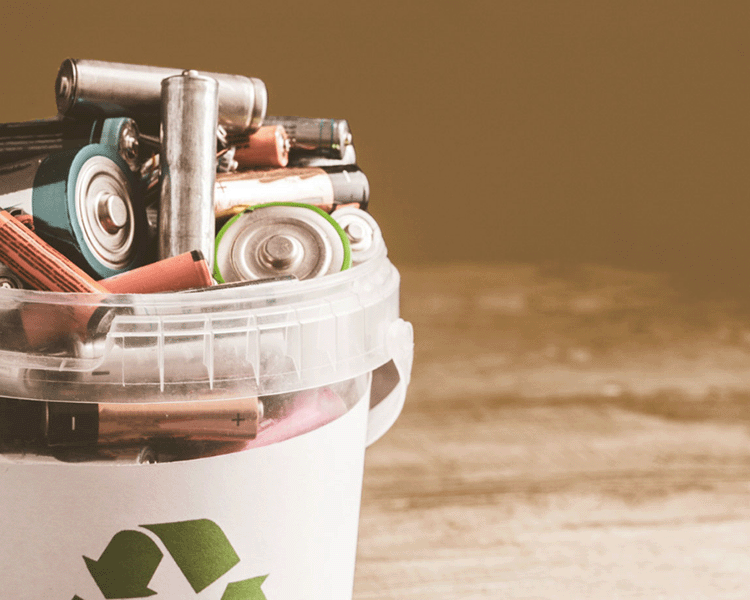







The battery law distinguishes between three basic types of batteries: Portable batteries, automotive batteries (also: starter batteries) and industrial batteries. Portable batteries are batteries that are encapsulated and can be held in the hand, but do not meet the requirements for automotive or industrial batteries. This type class includes most small batteries that are usually freely available in stores, such as in AA (Mignon), AAA (Micro), 9-volt block, C (Baby), D (Mono), or button cell standards.


Our Mission:
Resource Protection
We are committed to raise awareness of the importance of resource protection. By developing more sustainable products and packagings, VARTA is working for the preservation of natural resources for future generations.
Thanks to our new sustainable big packs, our Primary Batteries portfolio can now be offered completely plastic-free.
More sustainable materials are also being used in our products themselves. For example, our alkaline batteries already contain recycled materials.


Did
you
know?

Each battery (100 %) can be recycled, if added to the recycling process.
Consequently, many important metals can be reused.

In Europe, only about < 50 % of household batteries are returned to the circular economy via the appropriate collection points.

Empty Batteries end up in household waste

Batteries are forgotten in non-working devices

Empty batteries are not disposed as they are forgotten somewhere at home
Each year ~35,000 tons of batteries are improperly disposed of by EU households.

EU Green Deal
The collection targets for Europe are currently being revised and will be redefined in a few months.
Consumers are obliged to bring used batteries to separate waste collections, such as those offered by retailers.
By 2030, the proposed target is to increase the battery recycling rate to a new level of 73 %. In order to exceed this new goal, every single battery user is crucial.


Check
Batteries
Test your batteries if they are empty. For precise results, you can use the VARTA LCD Battery Tester.


Sort
Batteries
Remove empty batteries from the device and sort them by type. Lithium batteries (as well as coin batteries) must be protected before disposal, for example by taping off the poles, to ensure that no reaction can occur between the cells.


Recycling
Location
Used household batteries can be returned free of charge wherever batteries are sold, e.g. food retailers, drugstores, electrical retailers or DIY stores. Mostly, municipal recycling centers also take back used household batteries. Further information can be found either online (local websites, e.g. Battery Act, Environment Agency, etc.) or in striking distance of collection points.


Recycling
Process
Once the batteries are at the recycling yard, they are separated according to electrochemical systems through manual, electromagnetic, x-ray, and mechanical processes.


Acquired
Materials
In addition to the main resources, secondary resources can be recovered such as pig iron, zinc concentrate, slag, nickel, cobalt, copper and many more. These products can be reused for the production of everyday items, e.g. cars, road construction and new batteries.
Did
you
know?
On average 10 % of recycled batteries are still functional! Batteries that have been used in high drain devices can be tested and placed in low drain devices. If the low consumption device doesn't work, the battery is empty and ready to be recycled.
High Drain Devices


Devices with
high energy demand
Low Drain Devices


Devices with constant and
low energy demand

Conserving
Natural Resources
Recycling batteries also helps to conserve natural resources such as rare earths, zinc, copper, iron and manganese, reducing the need to mine new materials. This helps to preserve the environment and reduce the carbon footprint associated with mining and manufacturing new batteries.

Environmental Protection
If batteries mistakenly end up in household waste, the battery can be damaged by the pressing process of the garbage truck and even ignite. Recycling batteries helps to prevent them from contaminating soil, water sources and harming wildlife with toxins such as lead, nickel and cadmium.

Save
Energy
There are various devices that have different energy requirements. For this reason, battery manufacturers offer different battery ranges to optimally meet these requirements (e.g. VARTA Longlife, VARTA Longlife Power, VARTA Longlife Max Power). After a high drain device stops working, the battery can still be sufficiently charged to be used in another device with low power consumption.
CONSERVING RESOURCES AND RECYCLING OF RAW MATERIALS
Battery recycling ensures that raw materials are as completely recyclable as possible and helps to close the material cycle. This way, about 4 out of 5 batteries are fully recycled. An empty battery doesn't mean it's broken or unusable. It contains valuable raw materials that can be recycled and reused.

FAQ
What types of batteries are there?
What types of batteries are there?
Battery or rechargeable battery: what is the difference?
Battery or rechargeable battery: what is the difference?
What is meant by household batteries?
What is meant by household batteries?
What materials are recovered from recycled batteries?
What materials are recovered from recycled batteries?
How is an alkaline-manganese battery constructed?
How is an alkaline-manganese battery constructed?
Is my battery empty when my device stops working?
Is my battery empty when my device stops working?
Why battery recycling? Why should batteries not be disposed of in household waste?
Why battery recycling? Why should batteries not be disposed of in household waste?
Where can you dispose of used batteries?
Where can you dispose of used batteries?
Is the disposal of batteries free of charge?
Is the disposal of batteries free of charge?
What do you do with leaking batteries?
What do you do with leaking batteries?
How to recycle batteries?
How to recycle batteries?
How is electricity generated in the battery?
How is electricity generated in the battery?
Is an empty battery lighter?
Is an empty battery lighter?
How and where to store new batteries?
How and where to store new batteries?
How and where to store spent batteries?
How and where to store spent batteries?